News
Female wealth is reshaping luxury
Female wealth is no longer a future trend sitting somewhere on the horizon. It is already changing the balance of influence inside the luxury market. Women now control around one-third of retail financial assets in the EU and US and that share is expected to rise to 40 to 45% by 2030. In Europe alone, female-controlled assets are projected to reach $11.4 trillion by 2030. In the US, the number is expected to reach $34 trillion.
So the question is no longer whether female clients matter, but whether experience strategies are sophisticated enough to earn her attention, trust and loyalty.
This is where many brands still have work to do. The industry knows how to create elegant brand moments, but female engagement can no longer rely on softer styling, symbolic femininity or one-off events designed around outdated assumptions. As women become more influential as wealth holders, founders, collectors, investors, decision-makers and custodians of legacy, brands need to move from addressing women as an audience to understanding them as a relationship.
That shift requires a more precise experience strategy. One that reads different generations, recognises different motivations and designs moments that build confidence, relevance and emotional connection over time. Because the next chapter of female luxury engagement will not be won by the brands that simply host women better. It will be won by the brands that understand her world better.
The strategic shift: from targeting to reading
The strongest experiences do not start with the event format. They start with the client’s emotional and behavioural needs. This is something I have seen repeatedly from both the brand side and the agency side. Brands often begin with what they want to show, whether that is the collection, the craftsmanship, the story, the heritage, the campaign or the maison world. All of that matters, but it is not the full brief.
The more important question is what the client needs from the brand at this point in the relationship. She may need confidence, access, knowledge, privacy, peer connection or a better understanding of a complex category. She may need to feel recognised without being overexposed, or she may need to see herself not only as a buyer, but as a collector, decision-maker or custodian of legacy. This is where experience strategy begins. Female engagement should not be built around assumption, but around insight.
Women are not one audience and they are not a single segment. A female founder, a family office principal, a next-generation heir, a creative entrepreneur, an established collector and a long-standing private client may all sit in the same room, but they may not need the same thing from the brand.
Some women want expertise, while others want ease. Some want cultural relevance, while others want discretion. Some want to connect with peers, while others want to understand the value behind the object. Some are still developing confidence in a category, while others already understand the codes and simply want to be treated accordingly. The task is not to speak to women in general. The task is to read the women in front of you with greater precision.
The generational nuance
The growing importance of the female luxury client and female wealth become even more complex when viewed through a generational lens. Brands are not speaking to one female audience, but to several generations of women who relate to wealth, identity, heritage, service and experience in very different ways.
This is where experience strategy needs to become more precise. An established female client may look for discretion, continuity and personal recognition. A Gen X client may value substance, expertise and time well spent. A Millennial client may expect authenticity, craft and a clearer sense of personal meaning. A Gen Z client may be drawn to participation, cultural relevance and a more open relationship with the brand.
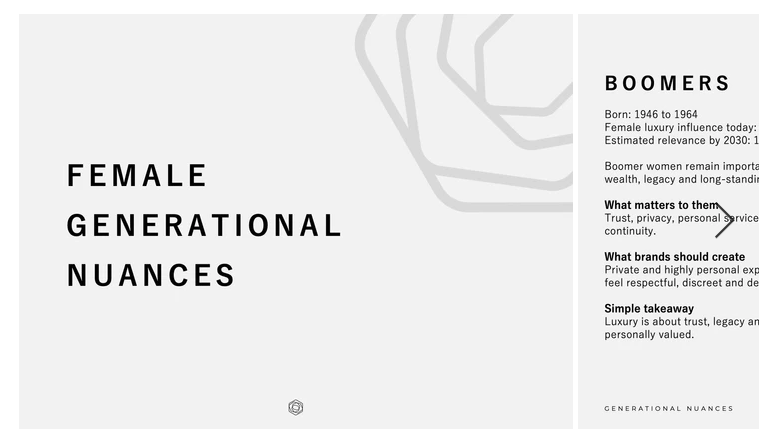
These differences matter because luxury engagement cannot be built around a single assumption of what women want. One generation may see luxury through the lens of legacy and long-term value, while another may need to understand why that legacy still feels relevant today. One may prefer quiet personal service, while another may look for access, dialogue and shared cultural meaning.
Designing experience strategies that work
This is where many luxury experiences become too executional too quickly. The first question should not be what the event should look like, but what role the experience should play in the relationship.
A private dinner can build trust, while a private salon appointment can create fluency. A cultural access moment can create relevance, while a behind-the-scenes encounter can deepen appreciation. A collector circle can build confidence, while an intergenerational conversation can connect legacy with future meaning.
The format only matters when the role is clear. Without a strategic role, even the most beautiful event risks becoming another moment in the calendar. This is especially important in complex luxury categories, where the brand world may carry deep heritage, technical knowledge, craft, collecting codes or social rituals. For some female clients, that world is familiar. For others, it can feel closed, formal or historically male-coded.
The opportunity is not to simplify the brand. The opportunity is to create fluency. A strong experience helps the client feel more confident inside the brand world. It gives her the confidence to ask questions, understand the craft, decode value, form her own point of view and move from admiration to attachment. That is when experience becomes more than presentation. It becomes a serious tool for relationship building.
When does female-only make sense?
Female-only experiences can be powerful, but only when there is a clear reason for the format. A female-only setting is not automatically strategic and it should never be used as a shortcut for relevance. It only becomes meaningful when it unlocks something that might not happen in a broader environment. It may create more openness, allow questions to be asked more freely, reduce the pressure of performative expertise, encourage peer exchange or help women build confidence in a category where they may historically have been treated as secondary clients.
If the format creates these conditions, it has a strategic role. If it does not, it risks becoming symbolic. The value of a female-only format is not that women are in the room. The value is what the room allows to happen. That is an important distinction. The strongest experiences are not softer versions of the main brand experience. They are more precise versions of the relationship strategy. They should not feel decorative. They should feel intentional, intelligent and relevant to the emotional role the brand wants to play in the client’s life.
From one-off moment to ecosystem
A single event can create attention, but attention is not the same as connection. This is one of the biggest opportunities in female engagement. Many brands still think in calendar moments, such as a lunch, a dinner, a launch, a private viewing or a seasonal activation. These moments can be useful, but with an audience this commercially and culturally important, the real opportunity is continuity. Female engagement should not be treated as a one-off moment. It should become a relationship ecosystem.
That does not mean creating more events for the sake of it. It means designing a sequence of experiences that build over time. One moment may create curiosity, another may build confidence, another may introduce expertise, another may connect women to each other and another may deepen emotional relevance. Over time, these moments create something much stronger than visibility. They create trust.
Thinking of female wealth, this is where some brands can differentiate from broader cultural platforms. Not every brand needs to compete through public visibility, social influence or large-scale cultural statements. Some brands are more powerful when they build quietly, privately and over time. For those brands, the opportunity is to create a more discreet relationship system. This could take the form of a rhythm of meaningful encounters that feel less like marketing and more like belonging. That kind of relationship is often much harder for competitors to copy, because it is not built through volume. It is built through trust, time and the careful orchestration of relevance.
The future belongs to brands that read better
The real opportunity is not to make female engagement more visible. It is to make it more intelligent. As female wealth grows, brands need to become better at reading the women they want to build relationships with: not as one audience, but as different generations of clients with different expectations, motivations and levels of confidence.
The brands that will lead are those that understand what each experience is meant to do, whether that is building trust, creating access, deepening knowledge or turning individual encounters into a lasting relationship.
The future is not about hosting women better. It is about understanding her world well enough to earn a lasting place within it.